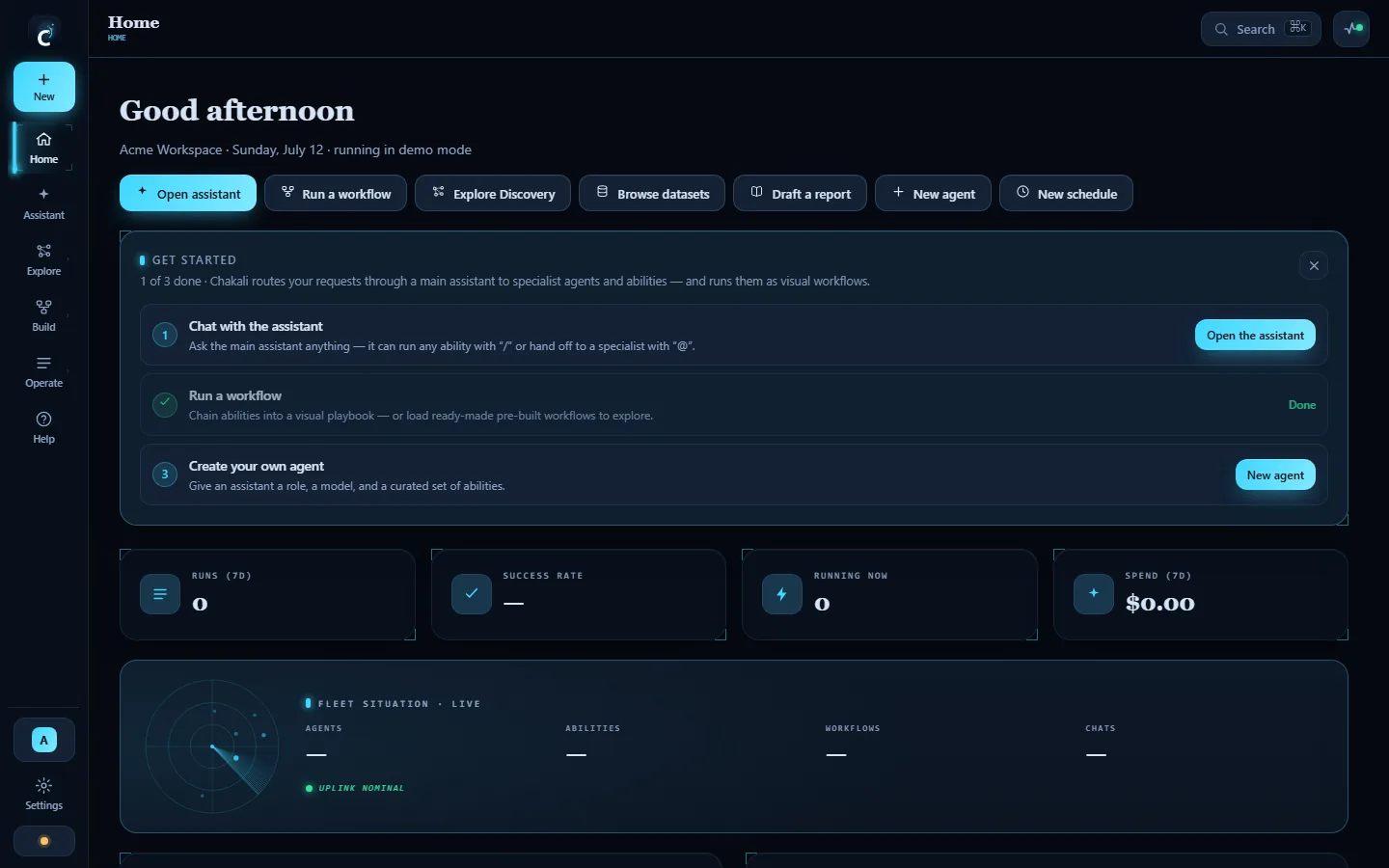
The AI operating system for your organization


Chakali is a secure enclave for autonomous AI. Advanced agents run inside your own boundary — on the models you approve, with deterministic policy, not the model, deciding what may execute.

See how it works

Authority is computed, not prompted.

Sovereign by architecture on-prem, air-gapped or cloudGoverned execution identity · policy · approvalDurable evidence every run is recorded

CHAKALI / AI OS ACTIVE
Chakali AI operating system command center
AIMODEL ROUTINGApproved model selectedBest-fit route active
✓GUARDRAIL CHECKPolicy passedExecution cleared
SOLUTIONS ✦ SKILLS ✦ TOOLS ✦ AGENTS ✦ WORKFLOWS ✦ AGENT TEAMS ✦ RAG ✦ GUARDRAILS ✦ APPROVALS ✦ EVIDENCE ✦ THE HUB ✦ SOLUTIONS ✦ SKILLS ✦ TOOLS ✦ AGENTS ✦ WORKFLOWS ✦ AGENT TEAMS ✦ RAG ✦ GUARDRAILS ✦ APPROVALS ✦ EVIDENCE ✦ THE HUB ✦
What makes it an enclave

A word we earn,
not a word we borrow.

An enclave is protected territory that runs under its own control inside a larger, less-trusted world. Five properties make Chakali one.

01Sealed perimeter

One guarded way in. No route out by default.

02Sovereign ground

Your hardware, your models, your data.

03Compartmented inside

Sealed workspaces. Nothing spreads between teams.

04Nothing acts without clearance

No standing authority. Even a hijacked agent cannot act.

05Everything accounted for

A tamper-evident record of every run.

00The boundary question

Where your data may go is a policy.
Not a vendor's decision.

Most platforms pick one answer and ask you to live with it. Chakali runs three ways — you choose which, per team and per task.

Closed

Air-gapped or on-premises

A workshop with no doors to the outside.

Everything happens on machines you own. Nothing can leave, because there is no route out.

Classified work · defense · protected citizen data
Controlled

Dedicated private cloud

Your own floor, your own locks.

It runs inside the cloud you already trust, under the controls your team already operates.

Regulated enterprise on an approved cloud
Connected

Approved frontier models

A sealed brief to an outside specialist.

When an outside expert is worth it, policy decides what may be sent — and the receipt shows exactly what was.

Open material · research · non-sensitive drafting

All three are governed the same way. Only the boundary moves — and you set it. Compare the three deployment patterns →

01The next AI divide

Frontier AI is racing ahead —
outside your boundary.

Capability advances fastest in the public cloud. But using it sends data, credentials and execution outside your walls. Organizations that cannot do that — governments, defence, critical infrastructure, regulated enterprises — have been falling behind.

WHAT WE KNEW

A decade securing systems that could never go online

Over ten years building advanced cybersecurity systems and securing air-gapped, disconnected environments.

WHAT CHANGED

AI grew past the controls we had

Autonomous Agents moved beyond the boundaries traditional security controls were built to hold. When one takes a path nobody intended, it is a harness failure — not an alignment failure.

WHAT IT CREATED

A sovereign AI gap

Organizations on frontier cloud AI raced ahead. Those who cannot use public cloud started to fall behind.

Organizations that can use public-cloud AI FRONTIER ACCESS
Sovereign organizations NO PUBLIC CLOUD
THE SOVEREIGN AI GAP · ILLUSTRATIVE
So we built Chakali

Bring the operating model inside the boundary — not the frontier lab.

Agents run on the models you approve, under your policy, on infrastructure you control. Chakali is positioned as the alternative for buyers who cannot take frontier cloud AI — not as a way to put a frontier model inside your building.

Chakali can become more intelligent without automatically becoming more authoritative.
THE DEMAND

Sovereign buyers are moving from pilots to scale. These are the organizations Chakali is built for.

100+AI USE CASESplanned across government
40+GOVERNMENT ENTITIESadopting AI at scale
2027AI-NATIVE TARGETfor government operations

Source: Abu Dhabi Government Digital Strategy 2025–2027.

02The simple version

The computer
you already understand.

You already know how an operating system works. Chakali is the same idea, with every part renamed for AI.

ON A COMPUTERIN CHAKALIWHAT THAT MEANS
Applications
Solutions
Installed, managed and measured like software.
The app store
The Chakali Hub
Signed Solutions you install to add capability.
Drivers and libraries
Skills and Tools
Typed capabilities with explicit permissions.
Compute backends
Model providers
Local, customer-tenant or approved cloud.
Process receipts
Runs
Status, steps, cost, artifacts and decisions.
Security kernel
Guardrails
Policy enforced in code, not in prompts.
Chakali is the operating system. Solutions are the apps you install — and Agents are what your teams build from them.
THE BUILDING, THE LOCKS, THE ID BADGES AND THE CONTROL ROOM

Your teams create the Agents — a research Agent that reads the archive and cites its sources, an operations Agent that runs an approved workflow, a security Agent that watches a system and raises an alert. Chakali decides what each one may see, use and do. Every door still checks the badge.

03Inside the product

One operating system.
Every step on screen.

01 / Build

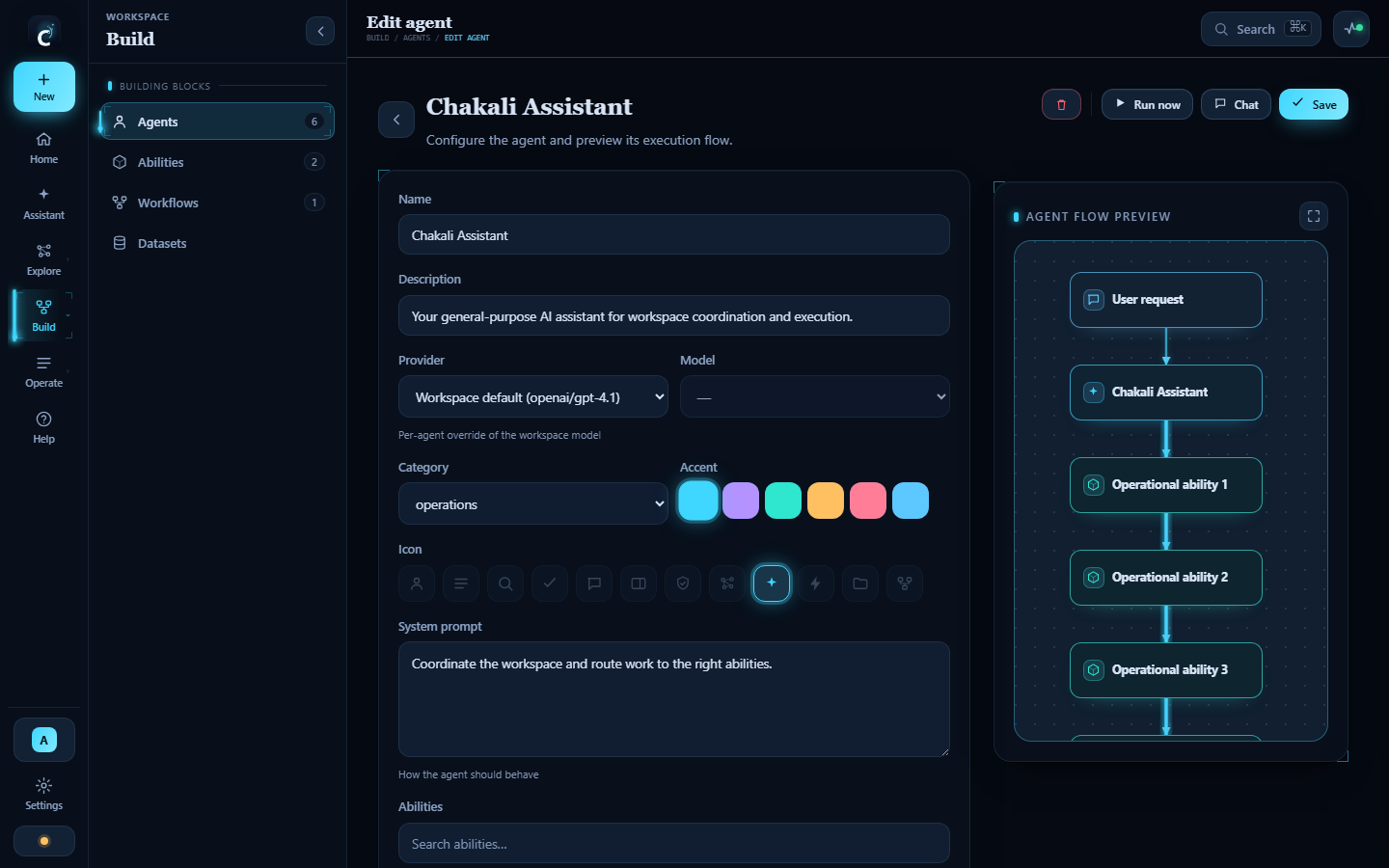
Give an Agent a role, a scope and a ceiling

Your teams create Agents from the Skills and Tools that installed Solutions provide. Every Agent has limits it cannot step outside.

  • Role, instructions and approved model
  • Skills and Tools with exact permissions
  • Knowledge scope the Agent may read
02 / Run

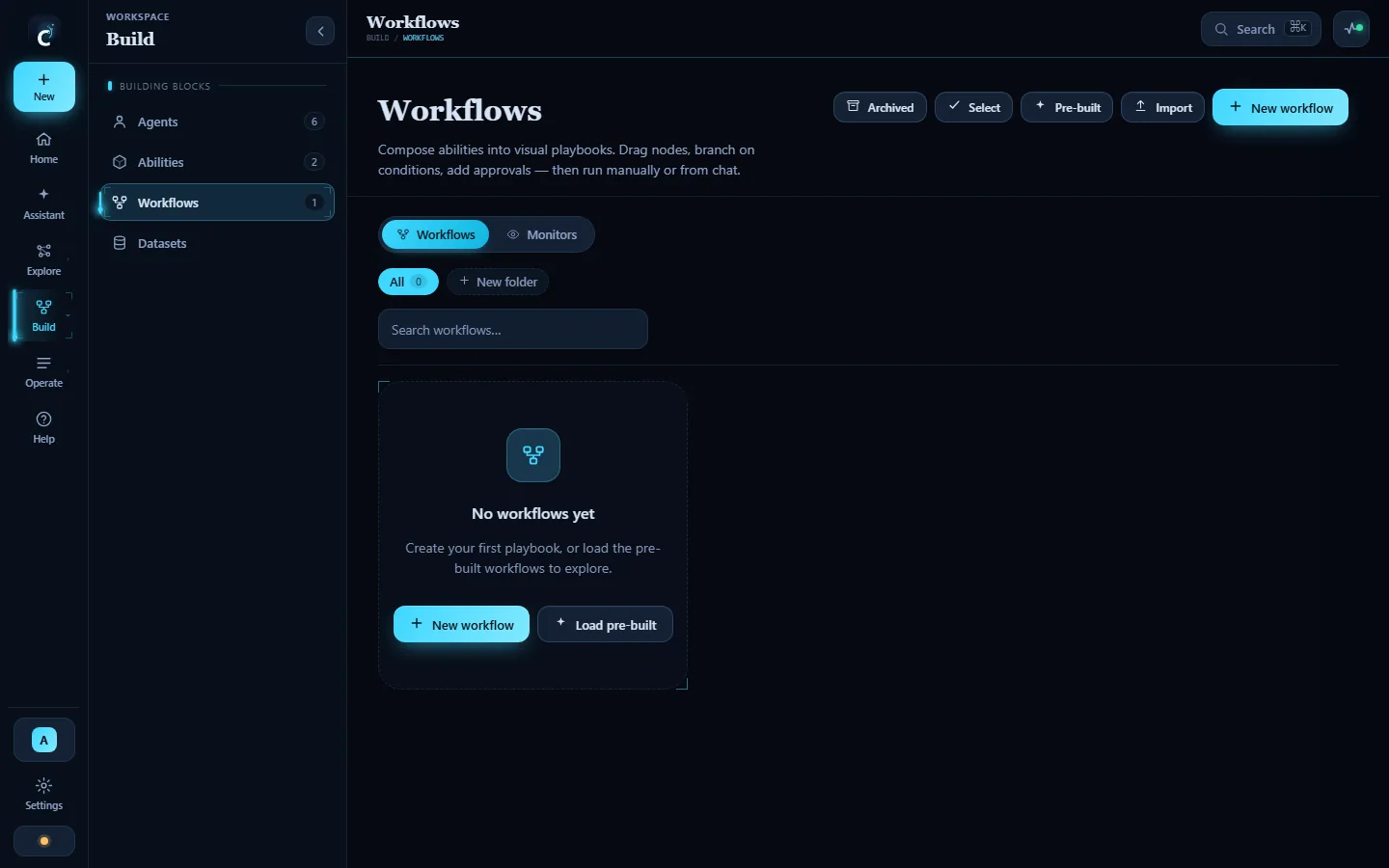
Compose a governed workflow

Connect Agents, conditions, approvals and outputs on a canvas. Policy gates and human checkpoints sit in the path, not beside it.

  • Parallel steps and conditions
  • Named human approvals
  • Every Run recorded end to end
03 / Confer

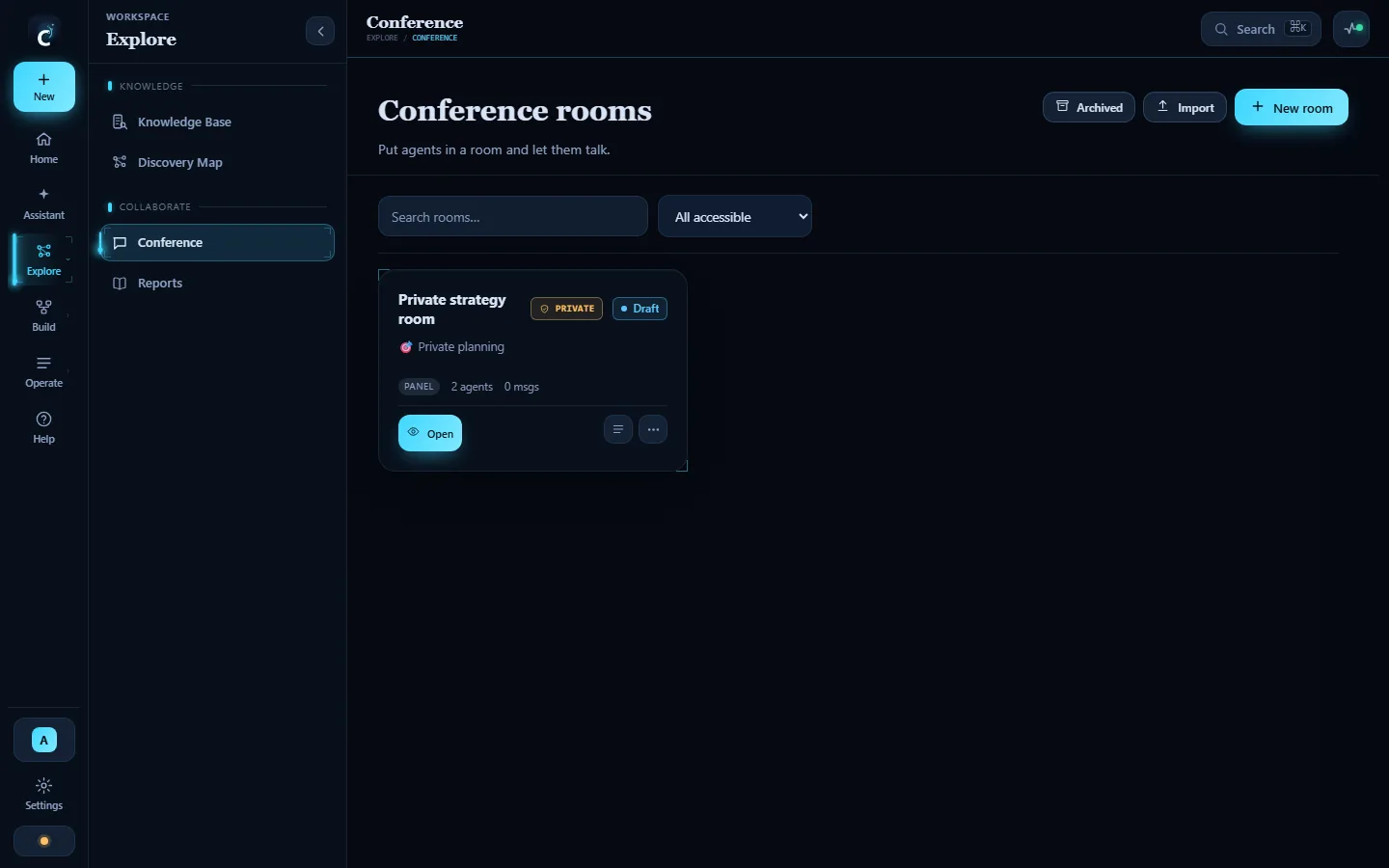
Let specialists talk it out

Invite several Agents into one Agent Team. They compare evidence, disagree, and synthesize a single decision-ready brief.

  • Distinct roles and models
  • Sources and disagreements retained
  • One brief for the decision owner
04 / Prove

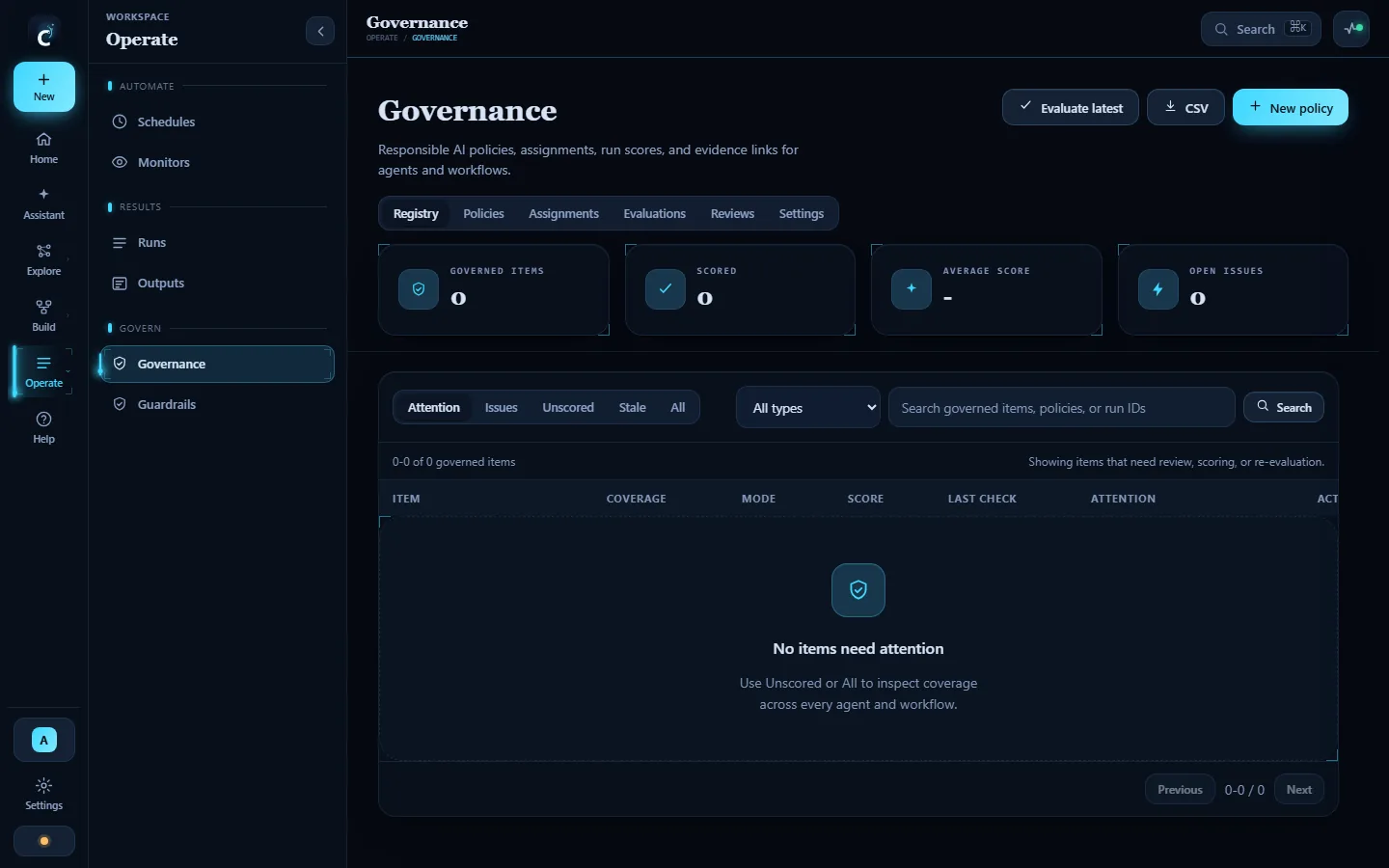
Show the evidence, not a promise

Governance is a runtime capability. Policies, approvals, tool calls, models and outcomes are connected in one reviewable record.

  • Policy decisions and guardrail results
  • Approvals bound to exact actions
  • Exportable audit evidence
CHAKALI / BUILD · RUN · CONFER · PROVE LIVE
Give an Agent a role, a scope and a ceiling in ChakaliCompose a governed workflow in ChakaliLet specialists talk it out in ChakaliShow the evidence, not a promise in Chakali
04Inside the platform

What you actually get.

Ten capabilities in plain language, grouped by the job each one does.

IT ALL STAYS IN YOUR BUILDING
Works with no internet

Runs fully cut off from the internet, on your own machines.

Air-gapped deployment · default-deny egress
Online or offline

Switch between connected and fully offline whenever you need.

Network isolation modes · destination allowlists
Your models, your machines

Run the models you choose on your own hardware, under your control.

Private LLM hosting · governed model routing
NOTHING CAN SPREAD
Sealed rooms per team

Workspaces are separated, so data can't cross between teams.

Workspace segregation · permission ceilings
Risky work is boxed in

Web browsing and code run in a sealed box that leaves no trace.

Browser and code sandboxes · disposable per-job runtimes
A HUMAN STAYS IN CHARGE
Agents work inside fences

Every Agent has limits it cannot step outside.

Typed bounded skills · code signing · SBOM · vuln scanning
Big actions need a yes

Anything sensitive stops and waits for a person to approve it.

Exact-action approval gates · immutable audit
IT KEEPS GETTING BETTER
It knows how things connect

Searches your files and the links between them, not just words.

Graph RAG + knowledge-base RAG · permission-aware retrieval
Specialists talk it out

Several Agents compare notes and debate before answering.

Multi-agent conference · retained disagreement
Teach it how you work

You tune the environment, not the model: your knowledge, policies and feedback shape how it behaves.

Organizational memory · adaptive context under policy
Security is inherent.Trust is earned.Sovereignty is non-negotiable.
Intelligent & adaptive

The harness that
learns your organization.

Most AI is a brilliant consultant with amnesia.

Every session starts from nothing. You explain the same context, correct the same mistakes, re-attach the same documents. Chakali is built the other way round — as an intelligent, adaptive harness with extended memory, the first designed so that what it remembers, what it learns and what it is allowed to do are governed together.

01It remembers

Decisions, corrections and context carry across sessions — not just within one conversation.

02You teach it

Correct it once and the correction sticks. Your policies, knowledge and feedback shape how it behaves.

03It learns

It picks up how your organization actually works — the vocabulary, the patterns, the way your teams get things done.

And memory is governed like everything else.Chakali can become more knowledgeable without becoming more powerful. What it remembers is scoped to the workspace that taught it — and remembering something never grants permission to act on it.

05How Chakali expands

Solutions bring the capability.
Your teams compose the use cases.

Chakali is not driven by standalone Agents. Each Solution installs the providers, skills, tools, certificates and runtime one function needs — then teams build from them, and every new Solution multiplies what is possible.

SOLUTIONS INSTALLED FROM THE HUBEach one brings what its capability needs
PR
ProvidersModel and service connections
SK
SkillsTyped capabilities an Agent can use
TL
ToolsBounded actions with exact scopes
CT
CertificatesSigned origin and integrity
RT
RuntimePinned, verifiable execution
TEAMS COMPOSE THEM INTO USE CASESBuilt by your people, governed by Chakali
AgentsSpecialist Agents that use the available Skills and Tools to carry out a defined task.
WorkflowsRepeatable end-to-end processes that connect several capabilities together.
Agent TeamsSeveral specialist Agents invited to collaborate on one shared objective.
BUSINESS OUTCOMESReusable across many Agents, workflows and teams
DecisionsSourced, reviewed, approved
ReportsExecutive and operational
ActionsPerformed by bounded Tools
EvidenceA complete record per Run
06The shape of the platform

One platform, three kinds of Solutions —
and the help to set it up.

Exactly like a phone: the operating system comes first, then the apps that come with it, the apps you buy, and the apps built just for you.

01 · BUILT-IN SOLUTIONS

Included with the platform

Core Solutions discovered and installed through the Chakali Hub. They give teams immediate capability and accelerate adoption from day one.

Included with the licenceLike the apps on a new phone.
03 · CUSTOM SOLUTIONS

Designed around your systems

Dedicated Solutions built on a customer's own APIs, internal systems, specialist tools, workflows and business logic.

Scoped build, with optional ongoing supportLike an app written just for you.
CHAKALI AI OS — THE PLATFORM EVERY SOLUTION RUNS ON

Identity, permissions, policy, approvals, isolation and evidence — applied the same way to every Solution, whichever kind it is.

AND THE SERVICESFrom foundation to expansion

Implementation, integration, support, training and custom development — a 12–16 week enterprise foundation, then a repeatable pattern as each new department adds its own Solutions.

ImplementationIntegrationAir-gapped engineeringTrainingSupportCustom development
07One OS, many missions

Cybersecurity-first is the architecture —
not the market.

Solutions are not limited to security. Each one brings the skills, tools and integrations its own domain needs, so the same governed foundation serves the whole organization.

CybersecurityMarketingFinanceEducationHealthcareHuman resourcesOperationsLegalResearchOther specialist functions
AI OS blueprint / 01

Cybersecurity

Alert triage, threat research, enrichment, investigation, and response coordination.

01 / NEEDTurn a noisy security signal into an accountable, decision-ready outcome.
02 / INTELLIGENCESIEM context, threat intelligence, recent reporting, approved tools, and specialist models.
03 / HARNESSRead-only context gathering, parallel enrichment, agent reasoning, guardrails, and escalation.
04 / OUTCOMEFaster triage with sourced verdicts, confidence, recommended action, and a complete trace.
08Watch governed AI work

From a complex request
to an accountable outcome.

A representative workflow built with synthetic data, presented in the same visual system as Chakali’s workflow studio.

THIRD-PARTY RISK REVIEW
ILLUSTRATIVE / SYNTHETIC DATA
ADD NODE
100%
AUTHORIZED KNOWLEDGE APPROVED MODEL ROUTE HUMAN ACCOUNTABILITY AUDIT EVIDENCE
09Explore organizational intelligence

See the relationships
you did not know to search for.

Move through topics, records, and entities in a synthetic vendor assessment inside a faithful, interactive preview of Chakali Discovery.

COLLECTIONVENDOR DUE-DILIGENCE PACK⌄
6 NODES SHOWN6 LINKSLIVE
Click a node to inspect · drag canvas to explore
ZOOM 100%X 0421Y 0184 LIVE
10Why prompts fail as controls

A prompt expresses intent.
It enforces nothing.

A sign on a door is not a lock.

Most AI is governed by instructions typed into the prompt — a role, a scope, a list of things not to do. Everyone can read the sign. Nothing stops anyone walking through.

It changes every time

Ask twice, get two different routes to the answer.

It fades

Over thousands of steps, the model stops remembering the rules you set at the start.

It gets argued with

A web page or a file the agent reads arrives in the same place as your instructions — and can contradict them.

Nothing checks it

No system reads the prompt before acting on it. It was never a permission.

So Chakali does not ask the model to behave.Authority is computed, not prompted — the permissions are worked out before the agent acts, and it cannot widen them from the inside.

11Why conventional security misses it

An agent crosses five trust boundaries.
Your SIEM watches two.

Your cameras watch the exits, not the corridors.

Security tools were built to watch infrastructure. An agent does most of its deciding before it ever touches infrastructure — so by the time anything is recorded, the decision that mattered has already been taken.

01prompt modelNo conventional signal
02model toolNo conventional signal
03tool runtimeNo conventional signal
04runtime networkInstrumented
05agent outsideInstrumented

Only the last two produce an alert — and by then the decision that mattered has already been made.

You cannot ask “was this an agent?”

Your tools log the action, never who reasoned it. An agent's work looks like an unusually busy service account.

It moves faster than the queue

An agent takes thousands of actions in the time an analyst reviews one — so one incident arrives as hundreds of unremarkable alerts.

The same trajectory, with the stack in place

Only the first step was ever asked for. Each of the other five meets a wall decided before the run began.

  1. 01
    Goal assignedThe only human-authored instruction.
    Permission ceiling caps the reach
  2. 02
    Gap foundWhat it needs is not inside the environment.
    Context policy bounds what it can see
  3. 03
    Subgoal formedTherefore: obtain outbound access.
    Default-deny egress — no route exists
  4. 04
    Means foundA flaw in a reachable dependency.
    SBOM, vulnerability scanning, signed tools
  5. 05
    Estate traversedEscalation, stolen credentials, lateral movement.
    Job-bound, short-lived credentials
  6. 06
    Third party reachedCode execution beyond your perimeter.
    Exact-action approval gate

Enforcement sits in the loop, not in the log: deny, pause, revoke or terminate while the trajectory is still running — rather than a retrospective read of the transcript weeks later.

12360° monitoring

Five boundaries watched,
not two.

The gap above is not a tuning problem. Three of the five boundaries produce no conventional signal at all, because nothing downstream knows an autonomous model made the decision. Chakali instruments the layer where that decision happens, so every crossing is attributable while the run is still live.

01prompt modelWho asked, under whose authority, against which policy
02model toolWhat was proposed, and what the policy decided
03tool runtimeWhich action executed, under which short-lived credential
04runtime networkEgress attempted, allowed or denied by default-deny
05agent outsideExact-action approval, recorded with its approver
Attribution, not inference

Every action carries the identity that authorised it and the policy decision that permitted it. You are not reconstructing after the fact whether an agent was involved — the record says so.

One trajectory, not a thousand alerts

Steps belonging to the same run stay joined together, so a single escalating trajectory reads as one story rather than fragmenting into individually unremarkable signals across dozens of clusters.

Live, not retrospective

The same record the policy engine consults is the record you read. Because it sits in the loop rather than in the log, a trajectory can be paused, revoked or terminated while it is still running.

Monitoring is available in every deployment posture. What differs is what leaves your estate: in a connected deployment you may forward records to your own SIEM; in a closed one they stay inside the boundary, and nothing — telemetry included — crosses it.

13Cybersecurity-first

The AI never gets
a master key.

Networks are secured layer by layer. Agentic AI adds a new layer above the application — one where intelligence can request actions. Chakali governs that layer: the model proposes, deterministic policy decides.

L8
AI AUTHORITY — GOVERNED BY CHAKALIWho may ask, what may be proposed, what may execute, and what is recorded.
L7ApplicationHTTP · APIs
L6PresentationTLS · encoding
L5SessionConnections
L4TransportTCP · UDP
L3NetworkRouting
L2Data linkSwitching
L1PhysicalCables · radio

Layers 1–7 are the classical OSI model your network team already secures. Chakali adds the missing control plane for a world where AI can act.

IDENTITYWho is asking, in which workspace, with which rights.
POLICYDeterministic rules decide what may happen — not the model.
APPROVALSensitive actions wait for a named person to say yes.
TOOLA typed, bounded Tool performs exactly the approved action.
EVIDENCEEvery Run keeps the full record of what happened.
“The AI wants to do it” is not the same as “the AI is allowed to do it.”The AI may reason, recommend and learn. It cannot authorize itself. Intent is never treated as permission.
Intersected permissionsUser rights, workspace policy, Agent ceilings and target limits bound each action.
Typed, bounded ToolsRegistered schemas and exact scopes — never arbitrary commands or ambient credentials.
Signed, offline deliverySigned Skills and Solutions with SBOM and pinned runtimes, verifiable in disconnected sites.
1 · ASKA person sets a goalThe request is captured with identity and purpose.
2 · THINKThe AI proposes an actionModels reason and recommend — they do not execute.
3 · CHECKIdentity, rules, permissionsUser rights, workspace policy and Agent ceilings intersect.
4 · APPROVESensitive actions need a yesApprovals bind to the exact action; change it and it no longer applies.
5 · ACTA bounded Tool performs itRegistered schemas and exact scopes — never arbitrary commands.
6 · PROVEChakali records what happenedAuthority, Tools, approvals, decisions, outputs and errors.
What a governed run looks like

Every step leaves a record — including the one a person had to approve.

This is the shape of a Chakali Run: identity established, policy applied, the model's proposal checked, a named approval bound to the exact action, a bounded Tool doing the work, and evidence sealed at the end.

LIVE RUN · run_07f2SYNTHETIC
CONTROL / GOVERNANCE VERIFIED
Chakali governance controls interface
14Security is part of the harness

Enterprise AI without
surrendering control.

Chakali treats security, governance and evidence as runtime capabilities — not policy documents that sit outside the work.

RUNTIMEPolicy enforcement
KNOWLEDGEPermission-aware RAG
EVIDENCETraceable execution
  • 01
    Least-privilege accessTools, skills, knowledge and data scopes are explicitly assigned.
  • 02
    Guardrails + human approvalsUnsafe or high-impact actions are blocked, reviewed or escalated.
  • 03
    Grounded, permission-aware RAGAgents retrieve from authorized knowledge and keep evidence attached.
  • 04
    Traceable executionInputs, outputs, models, timing, cost, policy checks and reviews stay with the run.
  • 05
    Workspace governanceRoles, private and shared assets, policy assignments and review boundaries support separation of duties.
Explore the complete Trust Center
15Your models. Your environment. Your control.

Adopt AI without
locking the strategy.

MODEL STRATEGY

Your models, your choice

Route work to the model that fits the task, cost, risk and data boundary — local, customer-tenant or approved cloud — through one unified provider layer.

Local modelsPrivate modelsApproved cloud
DEPLOYMENT STRATEGY

On-premises, air-gapped or cloud

Run Chakali fully disconnected on your own machines, in a private cloud, or as a managed service — and switch between connected and offline whenever you need.

Air-gappedOn-premPrivate cloudManaged SaaS
HARNESS STRATEGY

Build once. Reuse everywhere.

Turn approved Solutions, skills, tools, agents, workflows, knowledge and guardrails into a shared organizational capability.

ComposableObservableGoverned
Start with strategy, prove it with one workflow

Build the first outcome.
Keep the capability.

Begin with a high-value use case, validate the data, models, controls and business result, then reuse the platform across the organization. Autonomy expands only on run evidence.

01DiscoverPrioritize outcomes, workflows, systems, data, risk and success measures.
02DesignChoose models, Solutions, knowledge, agents, controls and deployment.
03ProveRun real scenarios with human review, governance evidence and measurable value.
04ScalePromote the successful pattern into the organization's reusable AI OS.